 Photo: FrDr / Wikimedia Commons
Champagne Wine Region Guide
When to visit Champagne: May and September are best — mild weather, September harvest, fewer crowds. Cellar tours from €25, TGV from Paris in 45 min.
Key takeaways
- Trip length: 3 days minimum to do justice to the region; 4–5 days ideal to cover Reims, Épernay and the Côte des Bar without rushing.
- Best months are May–June or September–October — avoid August, when Paris-on-holiday closures hit many growers and some Grandes Maisons run reduced hours.
- Base in Reims for first-timers (UNESCO chalk cellars, the Cathedral, easy TGV access); Épernay for the grower-producer tier; Hautvillers for a romantic small-village stay.
- Book the Grandes Maisons (Moët, Veuve Clicquot, Pommery, Taittinger) 3–4 weeks ahead — growers are more flexible, but Saturday afternoons fill fast in season.
Where to Stay in Champagne
Make the most of your Champagne wine trip by staying in the heart of wine country. From luxurious vineyard estates to cozy B&Bs, find the perfect accommodation near world-class wineries.
Top areas to stay
- Épernay€€-€€€
Avenue de Champagne — walk to Moët, Perrier-Jouët, Pol Roger
- Reims€€
Cathedral city with Veuve Clicquot, Taittinger, Pommery cellars
- Hautvillers€€€
Dom Pérignon's village, tiny and romantic
Visit midweek — many Champagne houses close weekends or require advance booking
Stay22
Compare Booking, Airbnb, Hotels.com and more in one search
Editorial pick
Best chateaux to visit in Champagne — top 10 picks 2026
Read the listicle →
Sample itinerary
3 days in Champagne — full day-by-day plan
Read the itinerary →
Where to stay
Where to stay in Champagne — best towns & wine-country hotels
Read the guide →
Vineyard hotels
Vineyard hotels in Champagne — 10 estates where you can stay
Read the guide →
Plan your visit: Plan your Champagne trip — free printable planner with maison itinerary, tasting notes, and budget tracker.
Champagne produces wine in one of the most tightly defined and legally protected appellations on earth — and nearly all of it is sparkling. That singular focus gives the region a clarity that most wine destinations lack. You're not here to compare styles or debate grape varieties: you're here to stand in chalk cellars carved two thousand years ago, drink wine that took three years to make from a glass you hold by the stem, and understand why the world chose this particular corner of northeastern France as the gold standard for celebration.
The region suits people who want structure and prestige — and it suits wine obsessives who want the opposite: the tiny grower-producers (look for 'RM' on the label) who farm a few hectares of Grand Cru vineyard and make 5,000 bottles a year, available almost nowhere except at the cellar door. Both experiences coexist here, often within a kilometre of each other on the Avenue de Champagne. If you're after a relaxed, rural wine holiday with walks between producers and no advance planning, go to Alsace or the Loire instead. Champagne rewards preparation.
The honest comparison is with Burgundy — both regions sell scarcity and prestige, both have a two-tier market (domaine vs négociant), and both charge accordingly. But Champagne is more visitor-friendly. Reims and Épernay are proper towns with good restaurants, efficient train connections from Paris, and a critical mass of open-to-public houses that Burgundy's village producers rarely match. Budget around €140–€170 per person per day for accommodation and meals in shoulder season; peak summer (June–August) runs 30% higher across the board.
Wine Regions & Appellations

The Champagne AOC covers roughly 34,000 hectares across five main growing zones, each with distinct chalk and limestone soils that affect what gets planted and how the wine tastes. The classification matters practically: Grand Cru villages (only 17 of them) command higher prices and tend to produce the most sought-after grower bottles.
Montagne de Reims
A forested plateau south of Reims with Grand Cru villages including Verzenay, Ambonnay, and Bouzy. Pinot Noir dominates, producing fuller-bodied Champagnes with red fruit character. Bollinger's vineyards sit here; so do Krug's parcels. Entry-level: Billecart-Salmon NV (~€45 retail). Grower tier: Egly-Ouriet (€60–€120 at cellar, appointment only).
Côte des Blancs
South of Épernay, this ridge of east-facing chalk slopes is almost exclusively Chardonnay — hence the name. The Grand Cru villages are Cramant, Avize, Oger, and Le Mesnil-sur-Oger. Blanc de Blancs made here have the highest acid and the best ageing potential of any Champagne style. Salon only makes wine in exceptional years (typically €400+). More accessible: Larmandier-Bernier Blanc de Blancs (€50–€70 at the cellar).
Vallée de la Marne
Stretching west from Épernay toward Paris, this valley is Pinot Meunier country — a grape that ripens reliably in heavier alluvial soils. The wines are fruit-forward, approachable young, and less fashionable than Côte des Blancs or Montagne de Reims, which makes grower prices here more reasonable. Hautvillers village sits in this zone — that's where Dom Pérignon worked, and his tomb is in the abbey church.
The Aube (Côte des Bar)
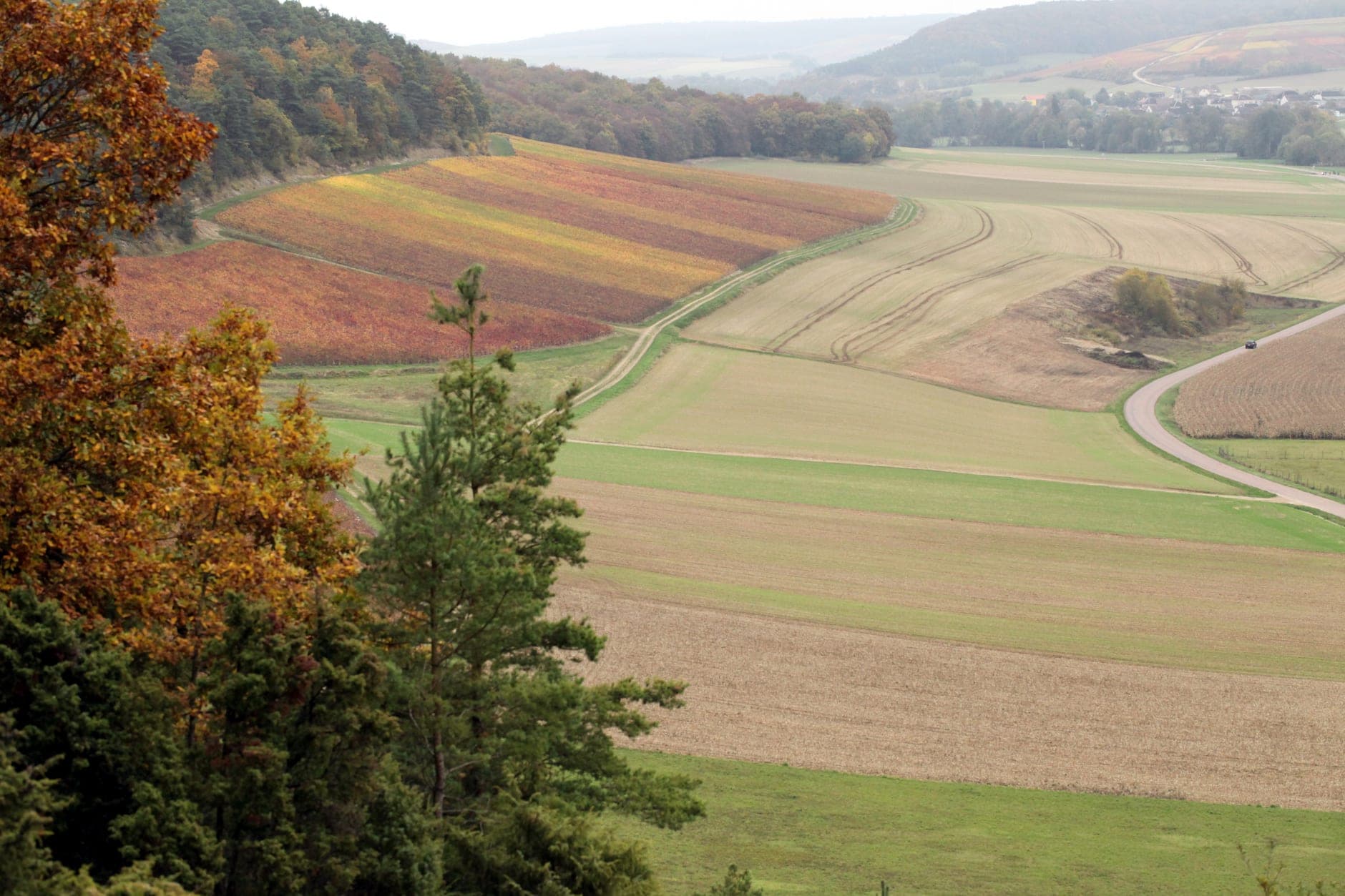
150 kilometres south of Reims, near Troyes, the Aube is geologically closer to Burgundy — Kimmeridgian limestone rather than chalk. Predominantly Pinot Noir. Less visited than the main zones, which means smaller crowds, friendlier walk-in policies, and prices 20–30% lower. Drappier is the largest local house and worth a visit.
Grape Varieties
Vine Cycle — Champagne
Full calendar →Champagne harvest is the only French harvest still largely hand-picked by law. Thousands of seasonal workers descend on the region. Expect festive energy, press house tours, and many houses closed to regular visits during peak picking.
Three grapes make nearly all Champagne: Chardonnay (30% of plantings), Pinot Noir (38%), and Pinot Meunier (32%). Chardonnay brings acidity, citrus, and white flower character — its best expressions come from the Côte des Blancs, where it's aged for a decade or more to develop brioche and mineral complexity. Blanc de Blancs is your entry point here: crisper and leaner than a standard NV, it pairs better with oysters and raw fish than the fuller-bodied blends.
Pinot Noir gives body, red fruit (strawberry, cherry), and structure. On its own in a Blanc de Noirs it can be revelatory — fuller than you'd expect from a sparkling wine, with enough texture to match roasted chicken or pork. The best come from the Montagne de Reims. Pinot Meunier tends to soften blends and improve early drinkability, though a small number of single-varietal Meunier Champagnes have become cult producers in recent years (Jérôme Prévost's La Closerie being the most famous, if nearly impossible to buy).
Four other varieties are permitted — Arbane, Petit Meslier, Pinot Blanc, and Pinot Gris — but collectively account for less than 0.5% of plantings. You'll occasionally see them in heritage blends from producers like Drappier. They're curiosities worth trying if you encounter them, but don't build an itinerary around them.
Understanding Champagne Styles
The label tells you almost everything you need to know before you taste. Non-Vintage (NV) is the baseline: a blend of multiple harvests that represents the house's consistent style, typically aged on the lees for 15 months minimum. This is what most people drink and what all the big houses are known for. Vintage Champagne is made only in exceptional years (2012, 2015, and 2018 are the current favourites), aged for at least three years, and priced accordingly — expect to pay €60–€120 for a mid-tier vintage versus €35–€50 for NV.
Blanc de Blancs (Chardonnay only, Côte des Blancs) is the region's most elegant style — high acid, fine bubbles, green apple and chalk character. It's the wine to order with a plateau de fruits de mer, and it ages exceptionally well. Blanc de Noirs (Pinot Noir and/or Meunier) is the opposite: fuller body, red fruit on the nose, often more approachable young. Rosé comes in two forms — assemblage (red wine blended in, allowed only in Champagne) or saignée (brief skin contact, rarer and usually more expensive). The assemblage method is more common at large houses; saignée tends to appear at smaller growers.
Prestige Cuvées are a house's flagship release — made from top parcels, aged longer, priced to reflect the brand. Dom Pérignon (Moët & Chandon) starts at €180 retail. Cristal (Louis Roederer) around €250. Belle Époque (Perrier-Jouët) around €150. If you're buying for the label, go ahead. If you're buying for the wine, many single-vineyard grower Champagnes at €60–€90 are more interesting — and you can taste them at the cellar for €20–€40 including a tour.
One practical tip: check the label code. NM (négociant-manipulant) means the house buys grapes from growers. RM (récoltant-manipulant) means the producer grew and made everything — this is the grower Champagne designation. RC (récoltant-coopérateur) means a grower member of a cooperative. CM (coopérative de manipulation) is the cooperative itself. MA (marque auxiliaire) means a supermarket or retailer's own-brand label — made by someone else. None of these is inherently better, but knowing the system helps you understand what you're paying for.
How Champagne Got Here
Romans planted vines in Champagne in the 1st century AD — the chalk geology that makes bubbles possible is the same geology that makes the region geologically unique in France. The Dom Pérignon story is well-known and mostly myth: he was a 17th-century Benedictine monk at Hautvillers who did genuine pioneering work on blending different village wines and improving cork technology, but he didn't 'invent' sparkling wine. Secondary fermentation in the bottle was already happening spontaneously in cold climates (the wine would re-ferment in spring once temperatures rose). What the Champenois did, over two centuries, was control and codify that process into the méthode champenoise we use today.
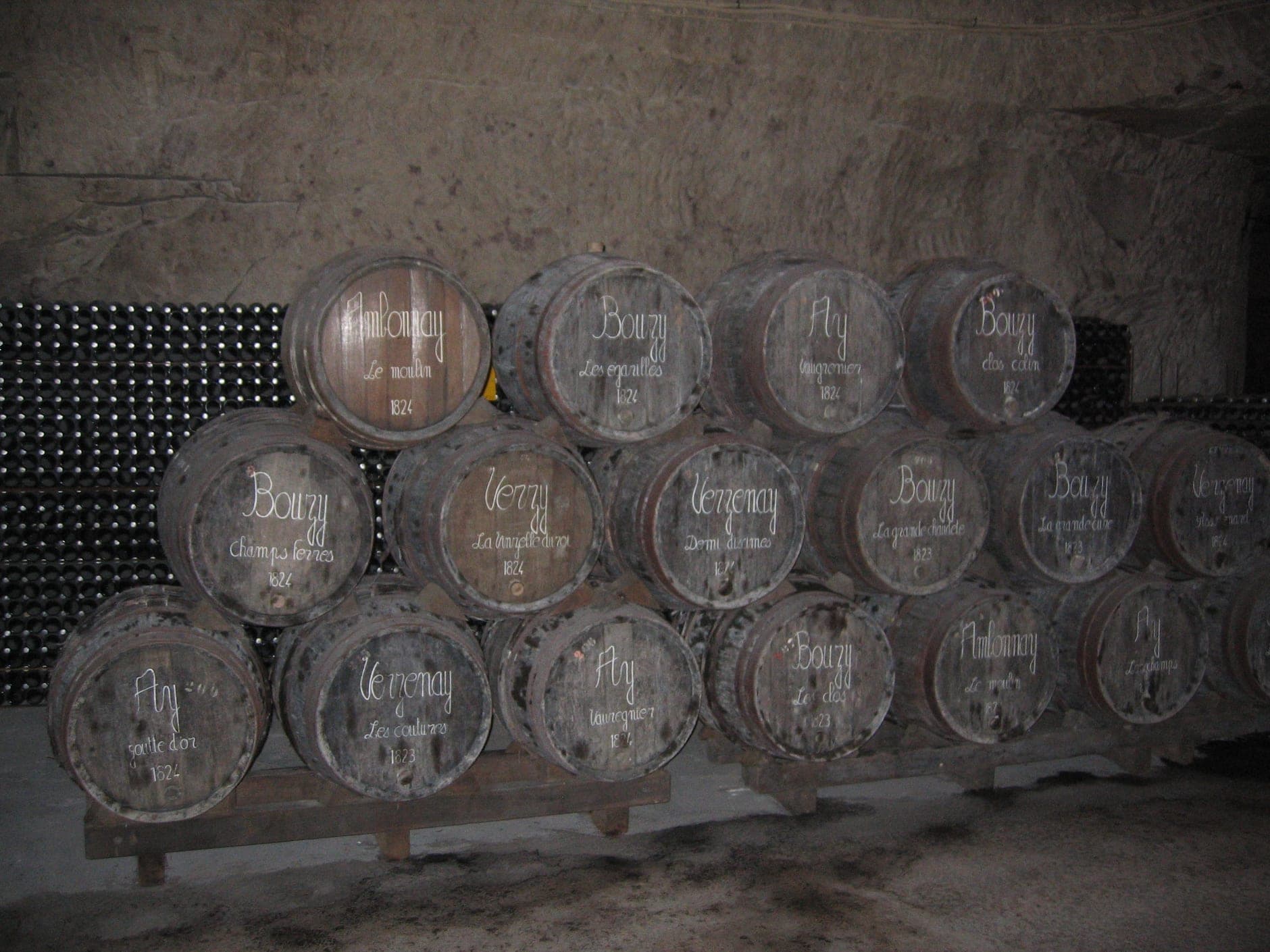
The great Maisons — Moët, Veuve Clicquot, Taittinger, Pommery — were largely built in the 19th century, when the widow Clicquot developed riddling (remuage) to clarify the wine of yeast sediment, and when Champagne was adopted as the drink of European royalty and the emerging bourgeoisie. The region's UNESCO inscription in 2015 ('Champagne Hillsides, Houses and Cellars') covers both the landscape and the underground chalk cellars (crayères), some originally quarried by Romans, that provide the stable cool temperatures for ageing.
Tasting Room Guide
Champagne operates on an appointment culture that Burgundy would recognise — but with a significant difference: the major houses have institutionalised tourism and offer public tours that can be booked online weeks, not months, in advance. The grower tier is the opposite: many are farmers who happen to make exceptional wine and receive visitors by email appointment only, usually one tasting per time slot. Plan your house visit first, then build grower appointments around it.
The Grande Maison Experience
Moët & Chandon (Épernay) — €30 for the standard cellar tour and two-glass tasting, €50 for the prestige experience including a Dom Pérignon glass. Book via their website 2–3 weeks ahead in summer. The cellars run 28 kilometres and house 90 million bottles; it's genuinely impressive infrastructure. The guide-led tour takes 60–75 minutes and ends in a tasting room. Best for first-time visitors who want scale.
Veuve Clicquot (Reims) — €25–€55 depending on tasting tier; the Histoire tour (€45) includes three cuvées and is worth the upgrade. Book via Clicquot.com, 2–4 weeks ahead. Their cellars are cut into Roman chalk quarries under the city — the temperature never varies from 10°C year-round. The riddling demonstration makes abstract wine chemistry tangible. Better for people who want to understand the process rather than just consume it.
Taittinger (Reims) — €35 including two glasses, walk-in possible on weekday mornings but booking ahead is safer. Their cellars incorporate a 13th-century abbey crypt and are among the most architecturally striking in Reims. Taittinger is one of the few remaining family-owned major houses, which shows in the tour — it feels less corporate than Moët or Veuve. Good for visitors who care about house ownership and provenance.
Pol Roger (Épernay) — €30, private tours by appointment only (email preferred, 3–4 weeks ahead). Smaller than Moët, more intimate, and the house Winston Churchill famously loved. Their Brut Réserve NV is a benchmark for the style. The tour is excellent precisely because the group sizes are small — typically under 12 people.
The Grower Producer Tier
Egly-Ouriet (Ambonnay, Montagne de Reims) — Appointment-only, €40–€60 for a tasting of 4–5 wines. Book by email at least 4–6 weeks ahead; English is spoken. This is one of the benchmark grower producers, known for low dosage wines from old Pinot Noir vines. The contrast with a major house tour is total: you'll taste in the family cellar with the winemaker or a family member, not with a group of 30 tourists.
Larmandier-Bernier (Vertus, Côte des Blancs) — Appointment-only, €40–€70. Biodynamic viticulture, a focus on terroir expression over house style. Their Latitude Blanc de Blancs (€50 at cellar) is a reliable entry point. Book via their website, 3–4 weeks ahead. This is the grower to visit if you want to understand how Côte des Blancs Chardonnay differs from the Montagne de Reims blends.
Jacques Selosse (Avize, Côte des Blancs) — The most discussed grower in Champagne and the hardest to visit. Appointments are rare and primarily go to wine professionals and importers; individual consumer visits are occasionally available but require patience and persistence by email. Tastings run €80 and up. Worth trying, but don't plan your trip around it.
Best value: the cooperatives. Nicolas Feuillatte at Chouilly offers cellar tours from €12–€25, walk-in friendly, with genuinely good NV and rosé. Cogevi in Épernay has a tasting bar with 15 producers' wines priced at €15–€20 for a flight of four. This is the entry point that won't feel like a tourist trap.
Cellar Etiquette & What to Wear
Champagne cellars run at a constant 10–12°C year-round — bring a jacket even in August. Closed-toe shoes are essential at houses with chalk cellars (Taittinger, Pommery, Ruinart, Veuve Clicquot); the floors are damp and uneven, and the long descents at Pommery (116 steps) and Ruinart (38m below ground) are not step-free.
Dress is smart-casual at the Grandes Maisons — think what you would wear to a nice lunch in Paris. Avoid perfume and strongly scented aftershaves; they interfere with tasting in the cellar. Photography is fine in the tasting rooms but check before pulling out a camera in the cellar — some houses restrict it to protect the resting bottles, and large-group flash photography is discouraged anywhere bottles are aging.
When to Visit Champagne: Month-by-Month
Monthly Climate — Champagne
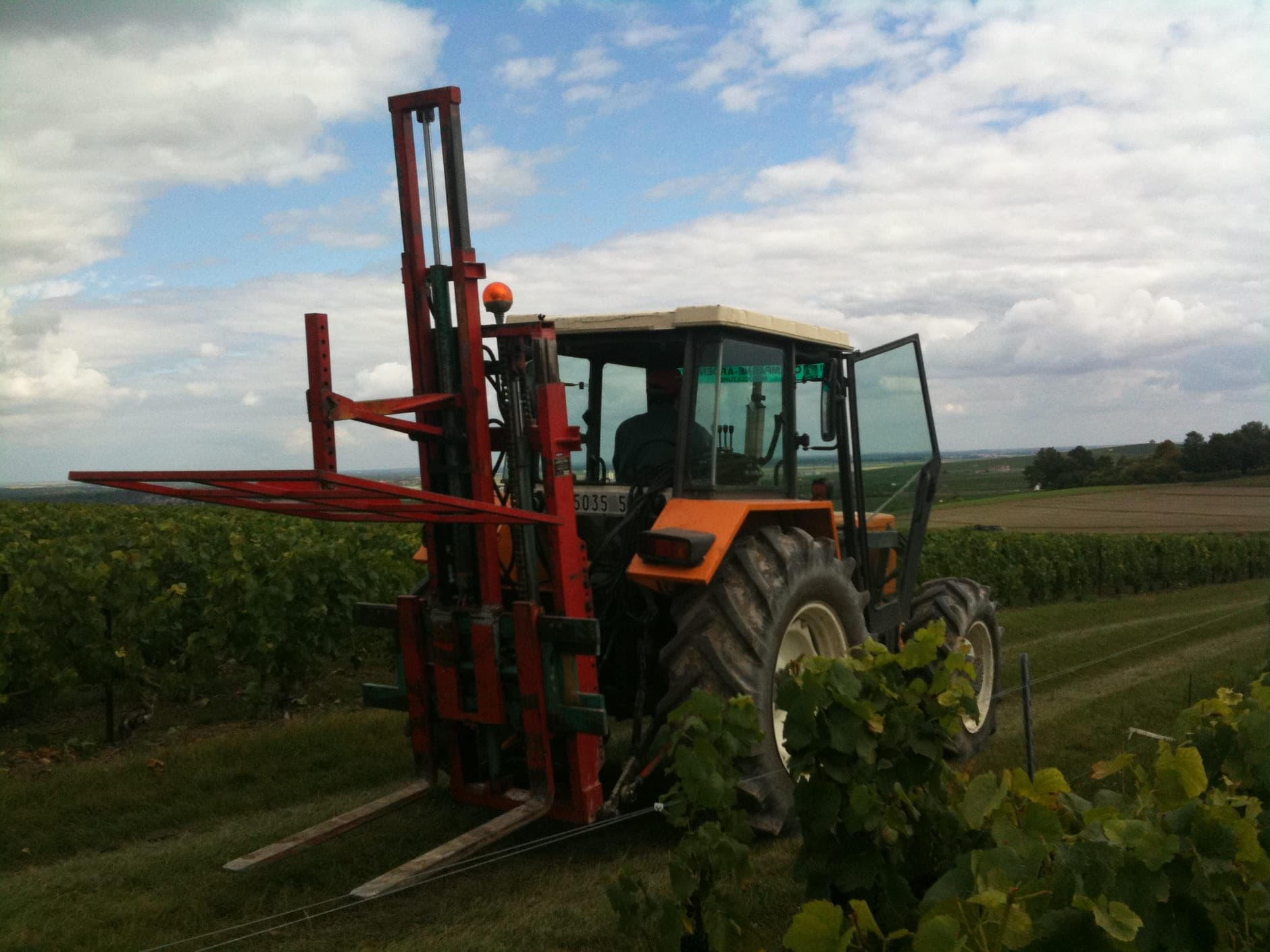
Full explorer →The sweet spot is May and September. May offers mild temperatures (14–18°C), the vineyards in full budbreak and early growth, and significantly thinner crowds than summer — major house tours are bookable within a week, and grower appointments are easier to secure. September is harvest month: Chardonnay typically picks 10–28 September, Pinot Meunier 12 September – 2 October, Pinot Noir from 15 September. This is when the region is most alive — pressing houses running 24 hours, workers in the vineyards, and many houses offering harvest-specific tours.
Summer (June–August) is the busiest period — peak season adds 30% to accommodation rates, and Moët's tours can fill 10–14 days ahead. The upside: outdoor tastings, longer daylight hours for the Route du Champagne, and the region's main events calendar. Average July temperature is 19–21°C; occasional heatwaves above 30°C are now annual. The crowds are real but manageable if you book ahead.
The contrarian choice is November–December. The Habits de Lumière festival in Épernay (second weekend of December) lights up the Avenue de Champagne with spectacular projections and free street tastings; it draws large crowds but the festive atmosphere is unlike anything in summer. The vines are dormant, so there's nothing to see in the vineyards — but cellar tours continue, and many houses offer special cuvées for the holiday season. Accommodation is 25% cheaper than peak. January–March is genuinely quiet: most smaller growers are receiving visitors, the big houses run reduced tour schedules, and you'll have the chalk cellars almost to yourself.
Getting There & Around
Getting There
The nearest major airport is Paris Charles de Gaulle (CDG), approximately 90 minutes' drive from Reims. From CDG there's no direct train to Reims — you need the RER B to Paris and then TGV from Paris Gare de l'Est. The faster option: take a taxi or transfer from CDG direct to Reims (around €120–€150 fixed fare, 75–90 minutes depending on traffic). Eurostar passengers from London arrive at Paris Gare du Nord, a 10-minute metro ride from Gare de l'Est. Direct flights to Reims do not exist from any major hub.
By train: Paris Gare de l'Est to Reims TGV takes 45 minutes and costs €20–€40 depending on booking time (SNCF/Ouigo — book in advance for cheap fares). Trains run roughly every 30–60 minutes through the day. Reims to Épernay by local train is a further 25 minutes, €7 one way. If you're based in Épernay and want to day-trip to Reims for cellar visits, the train works well. By car from Paris: A4 motorway to Reims (145km, around 90 minutes), then D951 south toward Épernay through the vineyards.
Getting Around
A car is not essential for visiting the major houses — Reims and Épernay are both walkable, and the train connects them. But a car is essential if you want to visit grower producers in the villages: Vertus, Ambonnay, Le Mesnil-sur-Oger, and Hautvillers are not served by useful public transport. Car hire from Reims station starts at €40/day for a small car. Parking at major houses is generally free. Cycling is possible on the Route touristique du Champagne (clearly marked, relatively flat through the Marne valley) but the Côte des Blancs has steeper gradients and is better for experienced cyclists.
For non-drivers, guided tours solve the problem: full-day minibus tours from Reims or Épernay typically include 3–4 house and grower visits for €90–€160 per person. Uber operates in Reims (not Épernay). Drink-driving laws in France set the limit at 0.05% BAC — effectively one glass for most people. Fines start at €135, licence suspension is immediate at 0.08%. Plan accordingly: designate a driver, book a guided tour, or use the train for the inter-city leg.
Driving the Route Touristique du Champagne
The Route Touristique du Champagne is roughly 700km of signposted roads through the appellation, marked with brown wine-glass signs at every turn. It is broken into five colour-coded circuits — the easiest way to structure a self-drive trip without having to stitch together a route yourself.
Massif de Saint-Thierry (blue) is the smallest, about 70km west of Reims through rural hamlets and old chalk pits — the least visited circuit, useful for a half-day if you want quiet roads. Montagne de Reims (red) is the headline route: a 70km loop south of Reims through the Grand Cru villages of Mailly, Verzenay, Verzy, Bouzy and Ambonnay, with the Verzenay windmill at 280m as the natural orientation point. Vallée de la Marne (green) runs 90km along the river through pinot meunier country and passes through Hautvillers, where Dom Pérignon is buried.
Côte des Blancs (yellow) is 30km south of Épernay through Chouilly, Cramant, Avize, Oger and Le Mesnil-sur-Oger — the chalk-and-chardonnay heart of the appellation, where the grower scene (Larmandier-Bernier, Pierre Péters) concentrates. Côte des Bar (purple) is 220km in the Aube département, southernmost and far enough from Reims that it usually only goes on the itinerary if you are combining with a Chablis trip. Pick up the free Route map at the Reims or Épernay tourist office; allow one full day per circuit if you want to stop for tastings.
Cycling the Montagne de Reims Grand Cru Villages
The Montagne de Reims loop is the most cycling-friendly part of the appellation — flat-to-rolling terrain through the Grand Cru villages of Mailly-Champagne, Verzenay, Verzy, Bouzy and Ambonnay. The Verzenay windmill (Moulin de Verzenay) sits at 280m and is the natural orientation point. The full loop is about 40km from Reims, with a shorter half-day version of around 25km if you cut the southern leg.
E-bike rental is widely available in Reims and Épernay from about €40 per day — recommended if you plan to taste and cycle, since the climbs out of Verzy can be punishing on a road bike. Several growers and cooperatives along the loop accept appointments from cyclists if you write ahead and explain the route; the Mailly-Champagne cooperative is one of the more flexible. Carry water and a layer — the chalk slopes are exposed, and the temperature drop in the cellars (10–12°C) is a shock if you arrive sweating.
Where to Stay
Split a 2–3 night stay between Épernay and Reims if you can — they're 25 minutes apart by train but serve different itineraries. Épernay is the wine town: smaller, more intimate, you can walk to Moët from most hotels. Reims is the city: cathedral, restaurants, museums, and the cluster of Veuve Clicquot, Taittinger, and Pommery all within 15 minutes of the centre.
Luxury (€350–€600/night)
Royal Champagne Hotel & Spa (Champillon, between Reims and Épernay) — €450–€700/night. Panoramic vineyard views, Michelin-starred restaurant Le Millésime, and a wine cellar with 400 references. The location is the selling point: 10 minutes from Épernay, 20 from Reims, and surrounded by Grand Cru Meunier vines. Book the vineyard-view rooms. Domaine Les Crayères (Reims) — €350–€550/night in a grand château with two Michelin-starred Le Parc restaurant. This is the city option for those who want to combine cathedral visits with serious dining.
Mid-Range (€120–€250/night)
Hôtel Jean Moët (Épernay) — €130–€200/night, boutique hotel 50 metres from the Avenue de Champagne. Comfortable, well-run, and genuinely convenient — you're 90 seconds from Moët's entrance. Hôtel de la Paix (Reims) — €110–€180/night, well-placed near the cathedral and Taittinger. The breakfast is good (local produce, regional cheeses) and parking is available. Both can be booked via Booking.com and are reliably full on summer weekends — book at least 3–4 weeks ahead.
Budget (€60–€100/night)
Daily Costs — Champagne
Full calculator →💡 Smaller grower-producers (RM on label) offer tastings at a fraction of big house prices
Campanile Reims Centre-Cathédrale — €70–€90/night, reliable chain hotel with free parking, a 10-minute walk from Taittinger and the cathedral. Good base for a cost-conscious trip. For a more characterful budget option: Gîtes and chambres d'hôtes in the Marne valley villages (Hautvillers, Cumières) run €65–€90/night and often include breakfast. Ask hosts to recommend nearby growers for tastings.
Where to Eat

Champagne's cuisine is richer and more substantial than you'd expect — it's northeastern France, not the Riviera. Potée champenoise (slow-cooked pork with vegetables), boudin blanc de Rethel (white sausage with cream and eggs), and local Chaource cheese feature on menus from brasseries to starred restaurants. The region pairs better with food than the 'aperitif only' reputation suggests.
Serious
Le Parc — Domaine Les Crayères (Reims) — Two Michelin stars, tasting menus from €185/head, wine pairing an additional €95. A formal grand château dining room with service to match. The Champagne list is extraordinary — 400+ references from major houses to obscure growers, priced from €55 to €1,200+. Book 4–6 weeks ahead. L'Assiette Champenoise (Tinqueux, 5 minutes from Reims) — Two Michelin stars, tasting menus from €160/head, food that references local ingredients more directly than Les Crayères. Book 3–4 weeks ahead.
Where Vignerons Eat
Café du Palais (Reims) — Art Deco landmark café-brasserie, €25–€45 per head for a proper lunch, Champagne by the glass from €8. Order the charcuterie plate, the boudin blanc if it's on, and the tarte fine aux pommes. Open daily, no reservation needed for the café counter. Bistrot Le 7 (Épernay, 7 rue Carnot) — €35–€55 per head, good wine list with grower Champagnes by the glass, popular with local house staff. Dinner reservations recommended Friday and Saturday.
Practical
Le Millésime at Royal Champagne Hotel (Champillon) — open to non-residents, Michelin star, €90–€130/head with vineyard views. Worth the drive for the setting alone. For something simpler after a tasting day: the Cave à Manger at C. Comme Champagne in Épernay serves cheese, charcuterie, and open Champagne bottles at the bar — €15–€30/head, no reservation, open afternoons into early evening. [verify open]
Wine Shops & Bars
La Fine Bulle (Épernay): Specialises in grower Champagnes — this is where you find RM-labelled bottles that don't reach retail. Good for tasting before buying.
C. Comme Champagne (Épernay): Tasting bar with over 350 Champagnes by the bottle and glass. The format is interactive — you browse the shelves, choose your bottle, pay a small corkage, and open it at the bar. Prices from €15 for a quarter bottle tasting up to €200+ for prestige cuvées.
Le Wine Bar by Le Vintage (Reims): Cozy bar with an extensive Champagne list, good food pairings, open evenings.
Attractions Beyond Wine
Reims Cathedral: Gothic masterpiece and coronation site of French kings — free entry, the stained glass in the south transept by Marc Chagall (installed 1974) is worth the detour alone. Open daily.
Palace of Tau (Reims): Former archbishop's residence adjacent to the cathedral, now a museum of coronation regalia. €8 adult entry. The coronation mantle of Charles X and Charlemagne's talismanic relic are displayed here.
Musée de la Vigne et du Vin (Épernay): Small but well-curated museum about viticulture and winemaking history, €5 entry, 45 minutes well spent before your first house visit.
Events
Habits de Lumière (Épernay, second weekend of December): Light projections on the Avenue de Champagne façades, street tastings, and parades. Free entry to the Avenue; individual house events require booking. This is genuinely special and worth planning a winter trip around.
Champagne Harvest Festival (September–October, various villages): Many houses run press-house tours and harvest participation events during vintage. Book directly with individual houses from July–August.
Fêtes Henri IV (Aÿ, July): Renaissance-costumed parades through this Grand Cru Pinot Noir village, with free tastings from local producers. A good excuse to visit the Aube and see a different side of the region.
Practical Info
Daily budget per person: Budget traveller (B&B, local brasserie, two tastings) — €140–€160. Mid-range (boutique hotel, one proper restaurant dinner, three house visits) — €240–€280. Luxury (Domaine Les Crayères or Royal Champagne, starred dining, private grower appointments) — €500–€700+. All costs in euros; Champagne is entirely within France so no currency conversion needed.
Tipping: Service is included in restaurant bills (service compris). Leaving an additional €2–€5 for exceptional service is appreciated but not expected. Tour guides at major houses do not expect tips but won't refuse them. Taxi drivers round up to the nearest euro.
Language: English is widely spoken in the tourist areas of Reims and Épernay, and at all major houses. In village cooperatives and smaller growers: Bonjour (hello), Merci (thank you), Puis-je goûter? (may I taste?), Une dégustation, s'il vous plaît (a tasting, please). Santé is the toast — use it and you'll be welcomed more warmly than if you don't.
Rookie mistake: Arriving at Moët & Chandon on a Saturday morning in July without a reservation and expecting to join a tour. The major houses are booked solid on summer weekends. Book any house visit before you book your accommodation — not after. The grower appointments are the ones to lock in earliest (they run on smaller capacities).
Frequently Asked Questions
How far is Champagne from Paris?
Reims is 145km northeast of Paris — 45 minutes by TGV from Gare de l'Est (€20–€40), or about 90 minutes by car on the A4 motorway. Épernay is a further 25 minutes south of Reims by local train. Champagne is one of the most accessible wine regions from a major European city.
How many days should I spend in Champagne?
Two nights is the minimum — one day for Reims (cathedral + two house visits), one day for Épernay and the Avenue de Champagne. Three nights lets you add a grower village day (Hautvillers, Vertus, or Aÿ) and one serious dinner. Five nights allows a proper immersion across all major zones plus the Aube day trip.
What is the best champagne house for a first visit?
Taittinger in Reims for first-timers — it's family-owned, the Roman chalk cellar is genuinely spectacular, and the tour is more personal than Moët's industrial-scale operation. Moët & Chandon is worth visiting for the sheer scale of the cellars and to see the Dom Pérignon estate in Hautvillers, but it's more of a tourist attraction than a tasting experience.
Do I need to book champagne house visits in advance?
Yes — for any visit between May and October, book at least 2–4 weeks ahead for major houses (Moët, Veuve Clicquot, Taittinger) and 4–6 weeks for grower producers. Krug and Dom Pérignon prestige experiences require 2–3 months. Walk-ins are possible at some cooperatives and at Taittinger on quiet weekday mornings, but not recommended as a strategy in peak season.
What is the best time of year to visit Champagne?
May for weather, thin crowds, and easy bookings. September for harvest atmosphere and the most activity in the vineyards and press houses. Avoid August if you dislike crowds — peak-season pricing plus the busiest tourist period.
What is the difference between Blanc de Blancs and Blanc de Noirs?
Blanc de Blancs is made from white grapes only (Chardonnay) — lighter, higher acid, lemon and mineral character, ages beautifully. Blanc de Noirs is made from black grapes (Pinot Noir and/or Meunier) with white juice — fuller body, red fruit character, more texture. Both are white sparkling wines; the difference is in grape variety and style, not colour.
How much does a champagne house tour cost?
Major house standard tours: €25–€35 including one or two glasses. Premium/prestige experiences: €50–€100. Grower producer tastings: €40–€80 (appointment only). Cooperatives and entry-level: €12–€25. The range is wide — a day visiting two major houses and one grower costs €100–€160 per person in tasting fees alone.
Can I visit Champagne without a car?
Yes, for major house visits in Reims and Épernay — both cities are walkable and connected by train (25 min, €7). You cannot visit grower producers in the villages without a car or guided tour. Full-day guided tours from Reims or Épernay (€90–€160) are the practical solution for non-drivers who want the complete experience including village producers.
Best for
- First-time visitorsReims-based tours of the Grandes Maisons — the UNESCO chalk cellars beneath Pommery, Taittinger and Veuve Clicquot are unforgettable on a first trip.
- Serious oenophilesCôte des Bar and grower-producers (Larmandier-Bernier, Selosse, Egly-Ouriet) — skip the brand-name tier and taste single-vineyard Champagne at source.
- Anniversary tripsBase in Hautvillers village, stay at Hostellerie La Briqueterie, and cycle the Vallée de la Marne — small-scale, romantic, vineyard-on-the-doorstep.
- Bachelor / bacheloretteÉpernay's Avenue de Champagne crawl — 2–3 maison flight tastings on one street, with easy Paris–Reims TGV logistics in and out.
Getting There
CDG — Paris Charles de Gaulle
90min drive
45min TGV from Paris to Reims
excellentCar rental recommended
Where to Eat
French — Champenoise
- €€€€
Le Parc — Domaine Les Crayères
fine dining
- €€€€
L'Assiette Champenoise
fine dining
Where to Stay in Champagne
- Épernay€€-€€€
Avenue de Champagne — walk to Moët, Perrier-Jouët, Pol Roger
- Reims€€
Cathedral city with Veuve Clicquot, Taittinger, Pommery cellars
- Hautvillers€€€
Dom Pérignon's village, tiny and romantic
Visit midweek — many Champagne houses close weekends or require advance booking
Stay22
Tours & Experiences
Champagne, France
Champagne house cellar tour & tasting
Guided tour of underground chalk cellars with prestige cuvée tasting
Small grower Champagne discovery
Visit 3 family-run grower-producers in the Vallée de la Marne
Wine Experiences
Visiting Wineries
Major houses (Moët & Chandon, Taittinger, Veuve Clicquot) offer public tours but require advance booking. Many Reims and Épernay houses can be booked 2–4 weeks ahead. Grower-producers in villages are often more flexible.
Book ahead: 1–3 months for major houses · Top estates: Krug, Dom Pérignon experiences: 2–3 months. Standard house tours: 2–4 weeks.
Planning tools & local info
Best for
- First-time visitorsReims-based tours of the Grandes Maisons — the UNESCO chalk cellars beneath Pommery, Taittinger and Veuve Clicquot are unforgettable on a first trip.
- Serious oenophilesCôte des Bar and grower-producers (Larmandier-Bernier, Selosse, Egly-Ouriet) — skip the brand-name tier and taste single-vineyard Champagne at source.
- Anniversary tripsBase in Hautvillers village, stay at Hostellerie La Briqueterie, and cycle the Vallée de la Marne — small-scale, romantic, vineyard-on-the-doorstep.
- Bachelor / bacheloretteÉpernay's Avenue de Champagne crawl — 2–3 maison flight tastings on one street, with easy Paris–Reims TGV logistics in and out.
Getting There
CDG — Paris Charles de Gaulle
90min drive
45min TGV from Paris to Reims
excellentCar rental recommended
Where to Eat
French — Champenoise
- €€€€
Le Parc — Domaine Les Crayères
fine dining
- €€€€
L'Assiette Champenoise
fine dining
Where to Stay in Champagne
- Épernay€€-€€€
Avenue de Champagne — walk to Moët, Perrier-Jouët, Pol Roger
- Reims€€
Cathedral city with Veuve Clicquot, Taittinger, Pommery cellars
- Hautvillers€€€
Dom Pérignon's village, tiny and romantic
Visit midweek — many Champagne houses close weekends or require advance booking
Stay22
Tours & Experiences
Champagne, France
Champagne house cellar tour & tasting
Guided tour of underground chalk cellars with prestige cuvée tasting
Small grower Champagne discovery
Visit 3 family-run grower-producers in the Vallée de la Marne
Wine Experiences
Visiting Wineries
Major houses (Moët & Chandon, Taittinger, Veuve Clicquot) offer public tours but require advance booking. Many Reims and Épernay houses can be booked 2–4 weeks ahead. Grower-producers in villages are often more flexible.
Book ahead: 1–3 months for major houses · Top estates: Krug, Dom Pérignon experiences: 2–3 months. Standard house tours: 2–4 weeks.
Explore Wine Regions in Champagne (France)
Côte des Blancs Wine Travel Guide (Champagne, France)
The Côte des Blancs, a prestigious sub-region of Champagne, is renowned for its exceptional Chardonnay grapes. This pict
Reims Wine Travel Guide (Champagne, France)
Reims, the unofficial capital of France's Champagne region, offers a perfect blend of history, culture, and world-class
The Aube Wine Travel Guide (Champagne, France)
Skip the tourist crowds — the Aube makes some of Champagne's most characterful wines. Grower visits, cellar routes, and
Épernay Wine Travel Guide (Champagne, France)
Épernay, located in the heart of France's Champagne region, is a must-visit destination for wine lovers. This charming t
Best Time to Visit Champagne
June-August
September-October
High in summer, low in winter
Average Monthly High (°C)
Moderate (650mm/year)Wines of Champagne
Key grape varieties and wine styles produced in the region
Primary Grape Varieties
Wine Styles
Food & Dining in Champagne
French — ChampenoiseMust-Try Dishes
- Biscuit rose de Reims
- Boudin blanc de Rethel
- Potée champenoise
Where to Eat
- €€€€
Le Parc — Domaine Les Crayères
Two Michelin stars in a grand château setting in Reims, exceptional Champagne pairings
- €€€€
L'Assiette Champenoise
Two Michelin stars in Tinqueux near Reims, innovative cuisine with deep Champagne cellar
Book starred restaurants well in advance. Visit during harvest (September) for the liveliest atmosphere.
Where to stay in the vineyard
Sleep among the vines — our pick of vineyard hotels and estate stays in France.
View France vineyard hotelsUpcoming Events in Champagne
Upcoming Wine Festivals in France
See all festivalsHidden Gems Nearby
Discover more hidden gemsDomaine de la Bongran
WTG PickBurgundy, France
A Burgundy rebel who makes Chardonnay on their own terms, far from the tourist trail of Beaune and Puligny.
Chardonnay
Domaine Huet
WTG PickLoire Valley, France
World-class Chenin Blanc with no queues, no hype, just pure Loire magic in a village setting.
Chenin Blanc
Mas de Daumas Gassac
Languedoc, France
Grand cru quality at a fraction of Bordeaux prices, in a wild, beautiful valley most tourists never find.
Cabernet Sauvignon · Rosé · White Blend
Continue Exploring
Did You Know?
We’re still gathering facts about Champagne. Tell us what makes it special
Ready to visit Champagne?
Build your personalised day-by-day itinerary — choose your travel style and trip length, get accommodation and tour picks per day, and email it to yourself to take along.
Plan Your Visit to Champagne
Tours & Experiences via GetYourGuide
This page contains affiliate links. We may earn a commission at no extra cost to you.